
FAQ / MANUFACTURER DIRECT
Who approves service entrance equipment? There is not always one reviewer with authority over every part of the decision. The engineer of record, local authority having jurisdiction (AHJ), and serving utility may each review different requirements, depending on the project and service arrangement. Their roles can overlap, but one review should not be treated as a substitute for another. Before ordering new equipment, confirm who must review the drawings, what documents each party needs, and whether approval is required before fabrication. Switchgear Builder Virginia can build custom equipment to the project requirements supplied for quotation; schedules, ratings, and applicable standards must be verified for the specific order.
Engineer of Record
The engineer of record (EOR) typically establishes the electrical design basis and reviews whether proposed service equipment matches the project documents. That may include system voltage, phases, service ampacity, available fault current, protective-device coordination, grounding approach, and connections to downstream distribution. The exact scope depends on the engineer’s contract and project requirements; the EOR does not automatically issue a permit or grant utility permission to energize. Buyers should ask whether the engineer will review manufacturer submittals, including the one-line diagram, elevations, dimensions, bus arrangement, device schedule, and marked options. Resolve discrepancies before approving production drawings: a changed breaker frame, bus rating, or incoming cable arrangement can affect coordination, footprint, and installation interfaces. Confirm who is responsible for final design approval, and provide the manufacturer with current, coordinated documents rather than relying on preliminary plans.
Authority Having Jurisdiction
The authority having jurisdiction is the agency or official responsible for enforcing applicable requirements at the project site. Depending on local arrangements, electrical plan review, permits, inspections, and acceptance may involve different departments or officials. The AHJ’s role is not interchangeable with the EOR’s design responsibility or the utility’s service requirements. Ask the local permitting office which submittals it requires, whether equipment documentation is reviewed before installation, and what inspection or approval steps apply before energization. Requirements can depend on the adopted code, amendments, occupancy, and project scope, so avoid assuming that approval on another job or in another locality settles the question. For a low-voltage switchboard, confirm whether the specified assembly must be UL 891 and how the requested listing or labeling applies to the quoted configuration. Any listing, inspection, or acceptance status should be verified for the actual equipment and jurisdiction.
Serving Utility
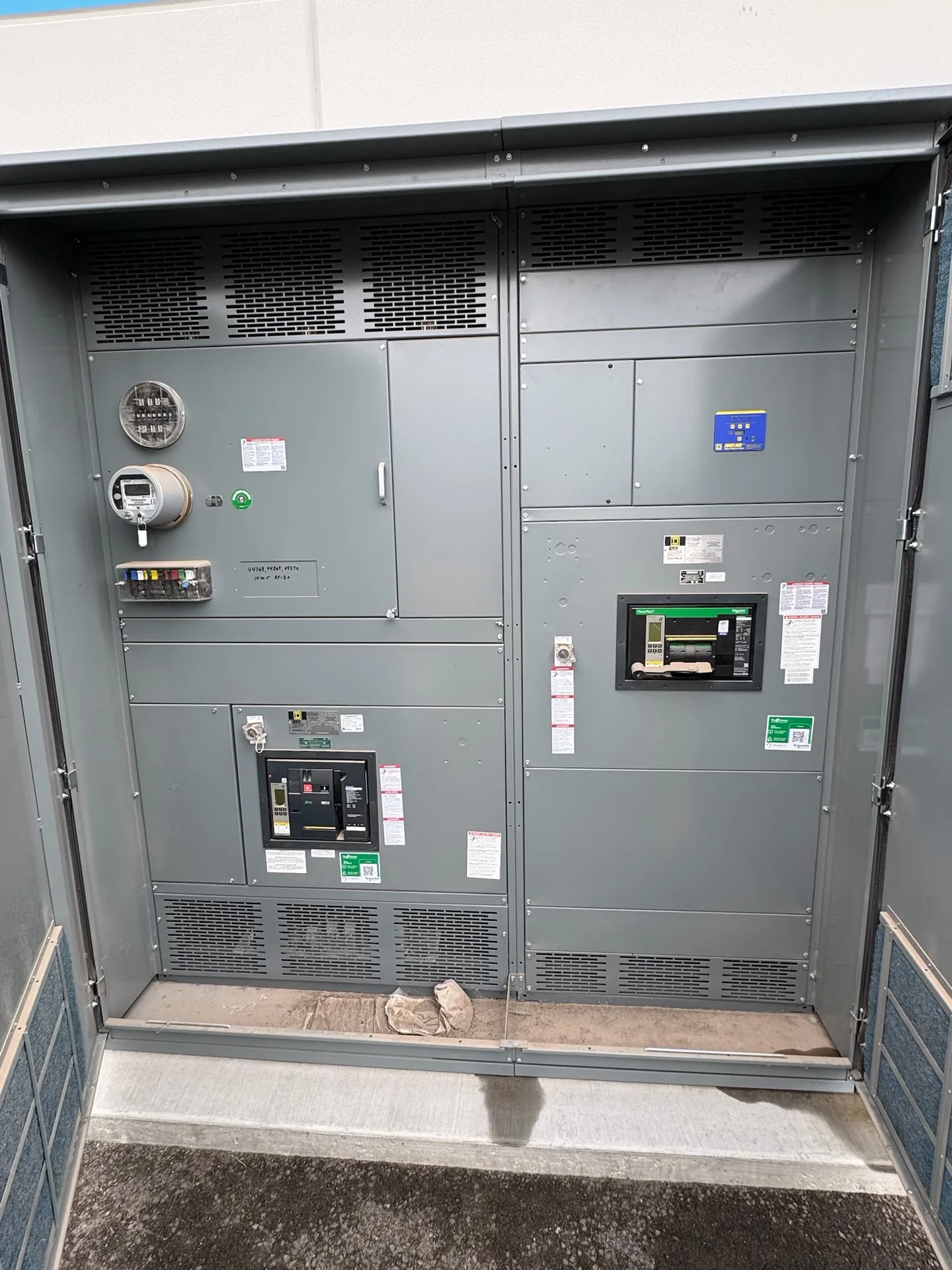
The serving electric utility may review the proposed service connection and impose requirements for the point of delivery, metering, service conductors, transformer interface, or access to utility-owned equipment. Its review is separate from a building permit and does not necessarily approve the customer’s complete distribution design. Determine early whether the utility wants a service application, load information, a one-line diagram, equipment dimensions, or meter-compartment details, and ask who provides written acceptance. Requirements can differ with service voltage, ownership boundaries, metering method, and available supply, so verify them with the utility serving the site rather than relying on a generic specification. Where utility and project documents appear inconsistent, resolve the interface before releasing drawings for fabrication. Do not infer that a utility review approves code compliance, equipment ratings, or installation methods outside the utility’s stated scope.
Confirm the Review Path
Create a simple approval matrix before equipment selection: list each reviewer, the documents required, who submits them, and what decision or signoff is needed. Distinguish design approval, permit approval, utility acceptance, equipment certification or labeling, field inspection, and authorization to energize; these are different checkpoints, not a single universal approval. Ask whether comments must be closed before fabrication, shipment, installation, or service connection. Record the applicable service characteristics and site constraints, including available fault current if established, incoming conductor direction, metering arrangement, enclosure location, and access clearances. If values remain unknown, identify the responsible party and timing for confirmation rather than guessing. A manufacturer can use an approved, coordinated specification to develop a custom build, but cannot determine every site authority’s decision. Written responsibility and document control help prevent late revisions, mismatched interfaces, and avoidable schedule uncertainty.
Submittals and Equipment Scope
When requesting a quote, provide the latest project specification, one-line diagram, equipment schedule, and reviewer comments, while clearly marking unresolved items. State whether the request is for a low-voltage switchboard or another equipment type; standards and approvals do not transfer automatically between product categories. Confirm the proposed configuration, interrupting or withstand requirements, bus ratings, service-entrance designation, metering provisions, and enclosure details against the engineer’s design and utility criteria. Treat each rating, listing, and feature as subject to review and written confirmation for the quoted assembly. Switchgear Builder Virginia manufactures new custom equipment in the USA using all-American components, with short lead times and nationwide shipping; actual configuration, schedule, and ratings remain subject to quotation and verification. Request a drawing review cycle and identify the people authorized to approve it. These steps clarify who decides what without implying that any one party approves everything.