
COMPARISONS / MANUFACTURER DIRECT
Switchgear and switchboards both distribute electrical power, but they are not interchangeable labels for one design. The useful comparison starts with system voltage, fault duty, switching needs, available room and how equipment must be maintained. Switchgear Builder Virginia manufactures new custom equipment in the USA with all-American components; the appropriate product family, configuration and ratings depend on project requirements and verification. Use the distinctions below to shape a specification, then compare proposals against the same one-line diagram and operating criteria.
Construction and layout
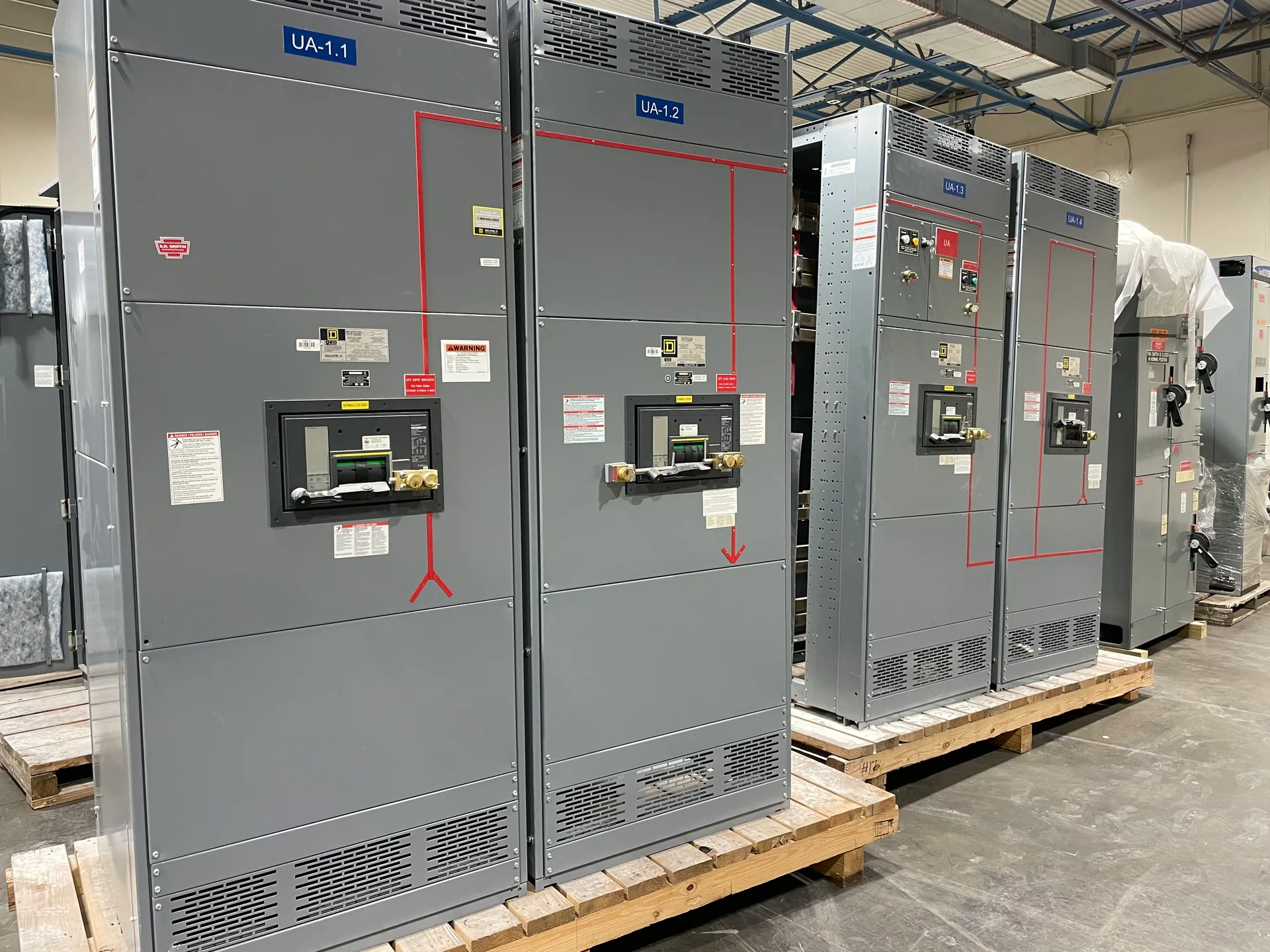
Low-voltage switchgear is commonly specified as a metal-enclosed assembly with circuit breakers in individual compartments; some designs use drawout breakers, while others use stationary devices. Compartmentalization can support isolation and organized access, but it usually takes more depth, width, and design coordination. A switchboard is generally a more compact assembly of sections carrying protective devices, bus, and distribution connections, often with less separation between components than a compartmented switchgear lineup. Exact construction varies by manufacturer and selected devices, so compare drawings rather than names alone. Check front or rear access, cable entry, section dimensions, barriers, equipment weight, and working clearances against the electrical room plan. For a custom build, Switchgear Builder Virginia can review the specified arrangement and project constraints; dimensions, construction details, and available options must be confirmed in the quote.
Protection and fault duty
Neither product family is automatically more protective in every application. The engineer should identify the available fault current, system voltage, protective-device functions, coordination objectives, and required short-circuit or interrupting ratings. Switchgear may be selected where breaker features, compartment separation, or operating arrangements support the system design. A switchboard may suit distribution where its devices and assembly ratings meet the verified duty. Do not compare an individual breaker rating with an assembly rating as if they were equivalent; request the applicable equipment rating and supporting documentation for the complete configuration. Where a low-voltage switchboard is specified for UL 891, confirm that the proposed assembly and its actual options fall within the applicable certification or evaluation scope; UL 891 is a switchboard standard, not a general medium-voltage switchgear standard. ([ul.com](https://www.ul.com/services/ul-891-general-coverage-program)) Have the project engineer verify protective-device selection and coordination.
Operation and maintenance
Consider who operates the equipment, what tasks occur, and what the owner can safely take out of service. Drawout breakers, when included, may allow a device to be moved to a defined position for inspection or replacement, but they add mechanisms, space, and procedures that require training and maintenance. Fixed-mounted devices can simplify the lineup and reduce certain moving parts, while maintenance or replacement may require a different outage plan. Compartments and barriers can help organize access, but they do not remove electrical hazards or make energized work safe. Compare the manufacturer’s instructions, device access, spare-parts strategy, maintenance intervals, and outage implications before choosing. Ask whether the proposed arrangement supports the owner’s isolation and operating procedures, and verify any interlocks or remote-control functions as specified. The practical choice is the one whose access and service approach matches the facility’s staffing, risk controls, and acceptable downtime.
Cost and project fit
Purchase price is only one cost factor. Compare enclosure footprint, installation labor, cable routing, switch-device selection, controls, metering, bus requirements, protection functions, and future expansion provisions on a consistent scope. More compartmentalized construction or drawout devices can raise initial cost and space needs, yet may fit operating or maintenance requirements that matter to the owner. A simpler switchboard arrangement may reduce complexity where its verified ratings and configuration satisfy the design. Neither option is inherently the lower-cost choice across all projects. Include freight, site access, rigging, anchorage, commissioning responsibilities, and any required studies or testing in the comparison, while assigning each item clearly between supplier and project team. Switchgear Builder Virginia offers custom new builds and nationwide shipping; lead time, scope, shipping arrangements, and pricing are subject to project review and quote. Avoid deciding from a headline price before technical exceptions are reconciled.
Choose by specification
Start with the one-line diagram and list the system voltage, source arrangement, available fault current, continuous load, feeder count, protective functions, access direction, environmental conditions, and future capacity needs. Then ask the engineer to identify the applicable product standard and required ratings for the actual assembly. IEEE C37.20.1 covers metal-enclosed low-voltage power circuit-breaker switchgear, while UL 891 concerns applicable low-voltage switchboards; requirements depend on product type and project specification. ([standards.ieee.org](https://standards.ieee.org/standard/C37_20.html)) Treat ratings, options, approvals, and testing as items to verify in the proposal, rather than assumptions based on the words “switchgear” or “switchboard.” Switchgear Builder Virginia manufactures in the USA with all-American components and can review requirements for a custom new assembly. Provide drawings, schedules, and site constraints for a quote; the final configuration, applicable ratings, schedule, and documentation require confirmation.